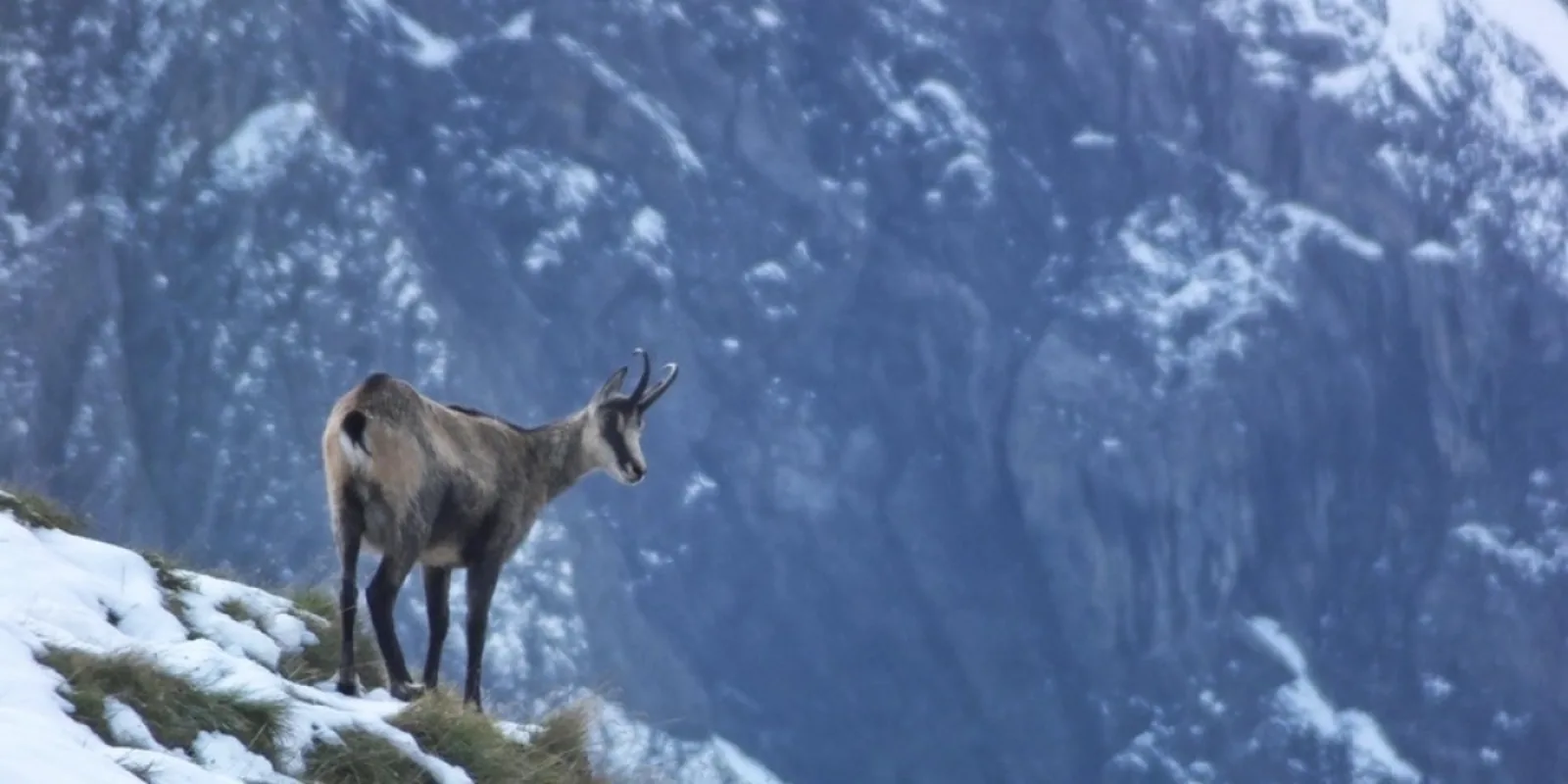
The chamois in winter, a perfectly adapted animal for the mountains
The Chamois is one of the emblematic animals of our mountains. It is found mainly in the Alps and the Pyrenees, but also in several other European mountain ranges. Agile and particularly comfortable on steep terrain, it has many advantages for coping with the difficult winter conditions.
When temperatures drop and snow covers the peaks, its fur becomes thicker and darker. This natural protection helps it retain heat despite the cold. Moreover, its hooves provide it with excellent grip on rocks and rough terrain. The chamois can thus move with remarkable agility on mountain slopes.
What do chamois eat in winter?
During the cold season, food naturally becomes more difficult to find. The The chamois therefore adapts its diet in winter to the resources available in its environment.
He particularly searches for dry herbs, twigs, buds, lichens, and various plants that are accessible despite the snow. When necessary, he can also scratch the snow layer to reach the vegetation below.
However, finding food requires a lot of energy. The chamois therefore limits its unnecessary movements during the most difficult periods. This strategy allows it to conserve its reserves and better withstand the cold until the return of spring.
Exceptional agility on steep terrain
The chamois has a morphology perfectly adapted to mountainous terrain. Its powerful legs and hooves allow it to move quickly over rocks, steep slopes, and uneven terrain.
This agility allows it to quickly reach difficult-to-access areas when it detects danger. In some regions, the wolf or lynx may be part of its natural predators.
However, the winter conditions also pose a real challenge. The cold, the snow and, above all, the lack of food force the chamois to manage their efforts with caution.
How do the chamois live during the winter?
In winter, several chamois can be observed grouped in areas where they find food more easily. The females and young live in groups, while the adult males can adopt a more solitary behavior.
During this period, their priority is to save their energy. The chamois thus alternate between feeding and resting, while limiting their movements when conditions become difficult.
It is also for this reason that it is necessary to avoid approaching wild animals during a hike, a snowshoeing excursion, or a day of skiing. A leak caused by human presence forces the chamois to spend valuable energy it needs to get through the winter.
Observe the chamois while respecting the wildlife
Observe chamois in its natural environment It remains a privileged moment for all mountain lovers. Nevertheless, this encounter must always be carried out at a distance so as not to disturb the animal.
If you spot chamois during your outing, avoid getting too close and keep your dog under control in areas where its presence is allowed. Binoculars also allow you to fully enjoy the observation without disturbing the animals.
Thanks to their fur, agility and ability to adapt their behavior to the seasons, chamois possess many advantages for living at high altitudes. Their observation also allows us to better understand the richness, but also the fragility, of the alpine environment. Wild fauna of our mountains in winter.