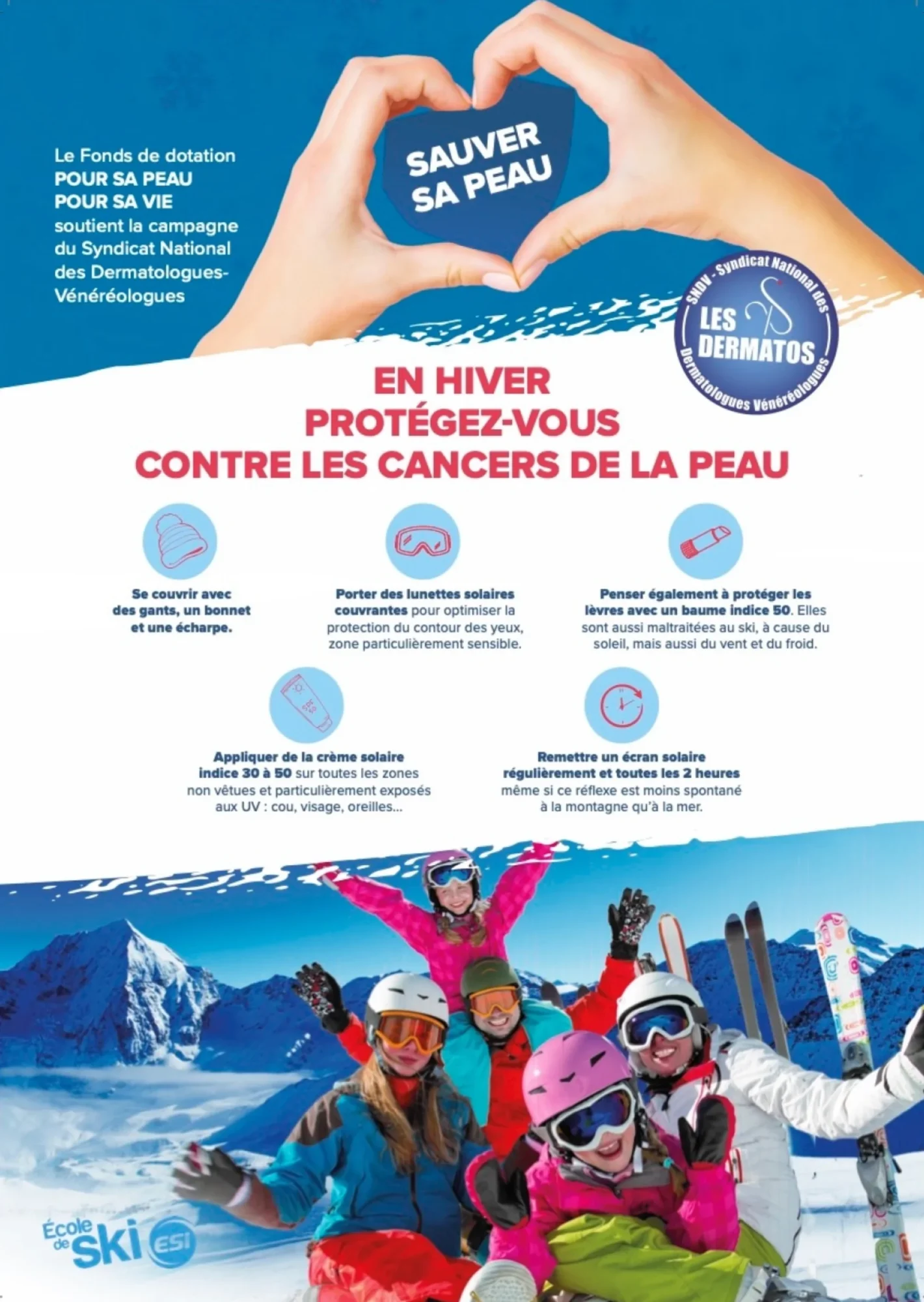
The harms of sun exposure in winter are sometimes underestimated or misunderstood by the French. That is why the National Association of Dermatologists-Venereologists (SNDV) and The International Ski School (ESI) For the second year in a row, they are launching a seasonal prevention campaign on the subject.
« To make the effects of solar radiation in the mountains more widely known. At the same time, providing advice on how to protect oneself better and ensuring that the sun remains a friend. This is today the goal of this awareness-raising campaign.», the union begins in a press release.
«Contrary to popular belief, the sun’s rays are no less dangerous for the skin in winter. Although UVB rays are certainly milder at this time of year, UVA rays are, although more dangerous, still present in equal measure., the doctors continue.
The essentials
- Overexposure to the sun can lead to skin cancers. But it can also accelerate aging.
- During winter holidays in the mountains, French people tend not to protect themselves adequately from the sun.
- The National Association of Dermatologists-Venereologists (SNDV) and the International Ski School (ESI) are therefore launching a seasonal prevention campaign on this subject for the second year in a row.
Winter holidays in the mountains: several factors amplify the harmful effects of the sun
It is also important to remember that in winter in the mountains, several factors amplify the harmful effects of UV rays. This increases the risk of skin cancer and premature aging even more:
– at altitude, the solar intensity is higher than in the plains. Indeed, the atmosphere is thinner and therefore filters out less solar radiation. The amount of UV thus increases by 10 for % every 1,000 meters of elevation gain and by 10 for every 1,000 meters of descent. The intensity is 30 % times higher in the mountains that at the beach.
– The reflection of the sun on the fresh snow increases the UV radiation by up % to 80%. This figure drops to 15 % on sand, 25 for % sea foam and only 10 for % lawns or soil.
– The cold in the mountains reduces the sensation of heat felt when exposed to the sun. This often leaves a sense of safety in the face of the UV rays.
Furthermore, French people tend not to protect their skin from the sun in winter, on the pretext that the coat, trousers and snow boots would protect the entire body from the rays. «And even though skiers often wear helmets, anti-UV eye masks, and sometimes a hood to protect the lower part of their faces, they become more vulnerable during lunch breaks on the terrace, where they take off their clothes to expose themselves to the sunniest hours of the day., It is part of the National Association of Dermatologists-Venereologists (SNDV).
«Another major risk concerns cross-country skiers or snowshoe hikers, who often neglect the wearing of a helmet or face mask and thus expose their facial skin more widely to solar radiation., health professionals also emphasize this.
Also read «How to avoid accidents on skis»